Consumed by Benjamin R. Barber
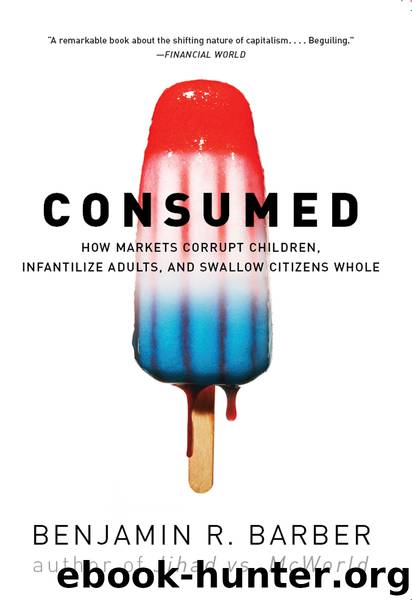
Author:Benjamin R. Barber
Language: eng
Format: epub
Publisher: W. W. Norton & Company
Published: 2007-10-14T04:00:00+00:00
6
Totalizing Society: The End of Diversity
The arts and sciences, less despotic though perhaps more powerful than government, fling garlands of flowers over the chains which weigh [people] down…causing them to love their own slavery.
—Jean-Jacques Rousseau1
IN THE FIRST decade of the new millennium, consumers find themselves trapped in a cage of infantilization, reinforced by privatization and an identity politics—call it an identity antipolitics—of branding. It is not necessary to label them victims of what earlier leftist critics called a kind of soft totalitarianism to see that their freedom may be compromised. Nor need we insist that they suffer, in the consumer choices they make, from what Marxists once liked to call “false consciousness” in order to suggest they may not be getting the social outcomes they wish for. The history of the brutal realities the term totalitarian captured certainly argues strongly against using it metaphorically to dramatize the lesser forms of manipulation that characterize market relations today. Nor does “false consciousness,” calling up images of people who literally do not know what they are thinking, willing, or doing, apply to today’s focused and knowing shoppers.
Yet there is something disturbingly flattening—not totalitarian, but nonetheless both totalizing and homogenizing—about consumer society under the subtle shaping influences of the infantilist ethos. And there is something defective about consumer choice when it repeatedly entails collective outcomes that are neither willed nor intended by individual choosers. Consumers are not citizens, and when a system pretends that they are, peculiar and even perverse things happen to decision making and to democracy, as well as democracy’s commitment to diversity.
Critics of capitalism in the postwar period, especially those German neo-Marxists associated with the so-called Frankfurt School, were already worrying—a little hysterically if also rather presciently—about the ways in which the successes of late capitalism seemed to them to be cloaking new and subtle forms of repression in the marketplace. If the market, with its hidden monopolies and invisible coerciveness, was “free,” then maybe freedom had (as the French philosopher Michel Foucault suggested) become a smoke screen for repression.
The Enlightenment had created worlds of liberty, privacy, and tolerance unknown to earlier societies. The new liberal ideologies that helped emancipate eighteenth-century men and women were oppositional (their targets were absolute monarchy and an authoritarian church). Since their ambition was to overthrow entrenched forms of political and ecclesiastical tyranny, their rhetoric was negative—suspicious of power and distrustful of government, even when it became democratic. But though it was understandably seditious in its oppositional phase, liberalism offered at best an ambiguous foundation for affirmative governance. Its intrinsic political promise was shot through with contradictions which were in part a reflection of the Enlightenment’s own ambivalences about power. Reason ruled—after all, it was the Age of Reason—but reason had become predominately instrumental. David Hume had snatched it from its noble classical perch as the defining human faculty that gave men access to the laws of nature and God, and reconceived it as a faithful slave of the passions—an adjunct, as it were, to man’s animal nature and to the power required for the satisfaction of animal interests.
Download
This site does not store any files on its server. We only index and link to content provided by other sites. Please contact the content providers to delete copyright contents if any and email us, we'll remove relevant links or contents immediately.
| Anthropology | Archaeology |
| Philosophy | Politics & Government |
| Social Sciences | Sociology |
| Women's Studies |
The Secret History by Donna Tartt(19105)
The Social Justice Warrior Handbook by Lisa De Pasquale(12197)
Thirteen Reasons Why by Jay Asher(8921)
This Is How You Lose Her by Junot Diaz(6894)
Weapons of Math Destruction by Cathy O'Neil(6285)
Zero to One by Peter Thiel(5808)
Beartown by Fredrik Backman(5769)
The Myth of the Strong Leader by Archie Brown(5513)
The Fire Next Time by James Baldwin(5454)
How Democracies Die by Steven Levitsky & Daniel Ziblatt(5225)
Promise Me, Dad by Joe Biden(5157)
Stone's Rules by Roger Stone(5091)
A Higher Loyalty: Truth, Lies, and Leadership by James Comey(4967)
100 Deadly Skills by Clint Emerson(4932)
Rise and Kill First by Ronen Bergman(4797)
Secrecy World by Jake Bernstein(4756)
The David Icke Guide to the Global Conspiracy (and how to end it) by David Icke(4724)
The Farm by Tom Rob Smith(4517)
The Doomsday Machine by Daniel Ellsberg(4493)
